What 35K THB Looks Like in BKK
How to Live Luxuriously Within a SINE Teacher Salary
When I first moved to Bangkok to begin teaching with SINE Education, one of the questions I received most often, especially from my American friends and family, was also one of the most difficult to answer: How much do you actually make?
It is an understandable question. Whenever someone considers moving abroad, particularly for work, the salary is usually one of the first practical considerations. How much will I make? How much will I spend? Can I afford an apartment? Will I have enough left over to travel? Is this actually a sustainable way to live?
As SINE teachers, we make 35,000 baht a month. What that number means, however, depends almost entirely on where you are standing when you look at it.
Converted into American dollars, 35,000 baht doesn’t sound particularly impressive. By Western standards, it is a modest income of $1,063.18 USD monthly, and I certainly wouldn’t want to pretend otherwise. Teaching in Thailand is not a path to getting rich, and I don’t think anyone should move across the world expecting their SINE salary to somehow make them wealthy.
But after more than a year of living in Bangkok, I’ve become increasingly interested in a different question. Rather than asking whether 35,000 baht is a lot of money, I’ve started asking whether it is enough money for the life I actually want to live.
For me, the answer has been surprisingly close to yes, but that doesn’t mean I live an extravagant life, nor does it mean that 35,000 baht would be enough for everyone.
My circumstances are my own, and there are plenty of expenses that another teacher might have that I don’t. But I think there is something useful in looking honestly at what my life actually costs, because the reality of living in Bangkok is considerably more nuanced than converting a Thai salary into dollars and deciding that it isn’t enough.
The biggest lesson I’ve learned during my second year with SINE is that living within your means doesn’t necessarily feel like a sacrifice when the means and the lifestyle are actually aligned.
And, perhaps more importantly, I’ve learned one of the easiest ways to make Bangkok affordable: stop trying to recreate the life you had somewhere else.

My Bangkok Budget, By the Numbers
My regular monthly income currently comes from several places. My SINE teaching salary provides the base foundation at 35,000 baht per month, while my side hustles of private tutoring, online tutoring (Preply, Cambly, Italki), and my writing add another 9,500 baht or so during a typical month.
That puts my regular monthly income at approximately 44,500 baht.
SINE also provides me with opportunities throughout the school year that don’t fit neatly into a monthly salary. I absolutely love being a part of producing our Teacher Trainings, and these bring in approximately 6,000-8,000 baht per term, while assisting with an English Camp provides another 3,000 baht per camp. I don’t count those as part of my regular monthly income because they aren’t guaranteed monthly expenses or earnings for me, but over the course of a school year they provide a much welcomed additional cushion.
Here’s what that looks like when everything is laid out:
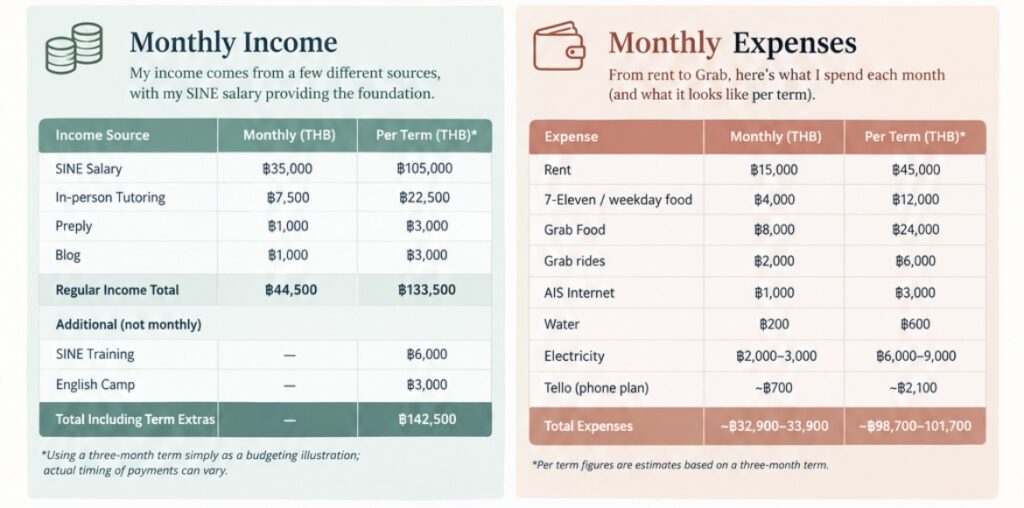
*Using a three-month term simply as a budgeting illustration; the actual timing of payments can vary.
On the other side of the equation, my regular monthly expenses are remarkably straightforward.
My rent is 15,000 baht. Electricity generally lands somewhere between 2,000 and 3,000 baht depending on the month, while water is only around 200 baht. AIS internet is another 1,000 baht, and my Tello phone plan works out to roughly 700 baht. I spend approximately 4,000 baht a month on my weekday 7-Eleven habit, around 8,000 baht on Grab Food, and another 2,000 baht on Grab rides.
That brings my regular expenses to approximately 32,900–33,900 baht per month.
That leaves approximately ฿10,600–11,600 per month from my regular income before savings, travel, unexpected expenses, or whatever other spending happens to come along.
My SINE salary of 35,000 baht essentially covers my core monthly expenses. The additional money I earn from tutoring and writing gives me the breathing room to actually enjoy the city I’m living in. I will be honest I’m probably among the more high-maintenance SINE Teachers in terms of my lifestyle coming from NYC and LA – I like the finer things and I’m happy to work a little harder and be entrepreneurial to have them.
SINE pays for my life. My side hustles pay for my lifestyle.
The Apartment That Made the Math Work
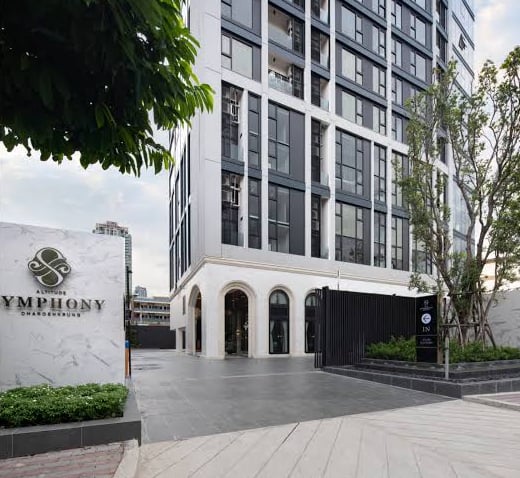
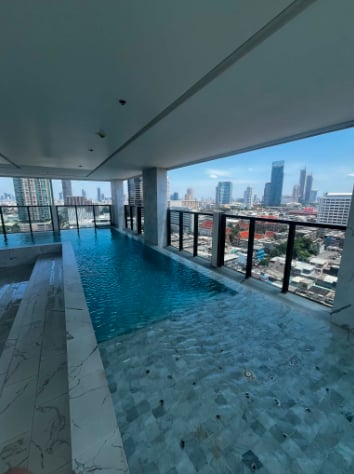
One of the biggest pieces of that equation is housing.
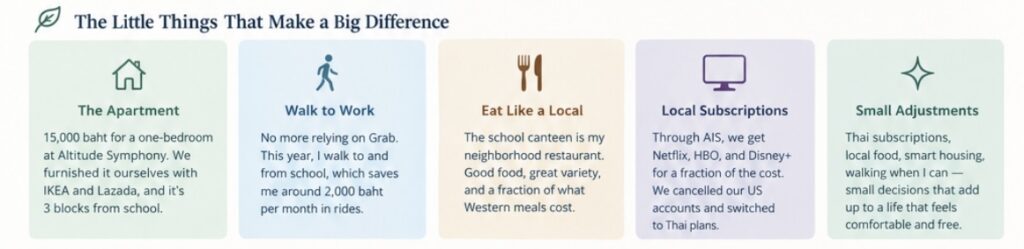
I pay 15,000 baht a month for a one-bedroom apartment at Altitude Symphony, only about three blocks from Wat Suthiwararam. The building has a rooftop and swimming pool, and, by my own admittedly subjective definition, it is a pretty luxurious place to live.
There is a reason I can afford it, though. We furnished it ourselves, by choice, and conducted the entire tour and negotiation in Thai. Bangkok can be very affordable, especially if you learn to do things the Thai way.
Rather than paying a premium for a fully furnished apartment marketed toward Western expats, we bought what we needed from IKEA and Lazada and gradually made the space our own. There is something particularly satisfying about that process.
After my first year, when I was still figuring out Bangkok and relying much more heavily on Grab, the difference has become surprisingly noticeable. This year, my commute costs me nothing. I simply leave the apartment, walk down the street, cross a few roads, and arrive at school.
It is a small thing, but these small things are exactly where the budgeting begins to work.
Learning to Eat Like a Thai Student
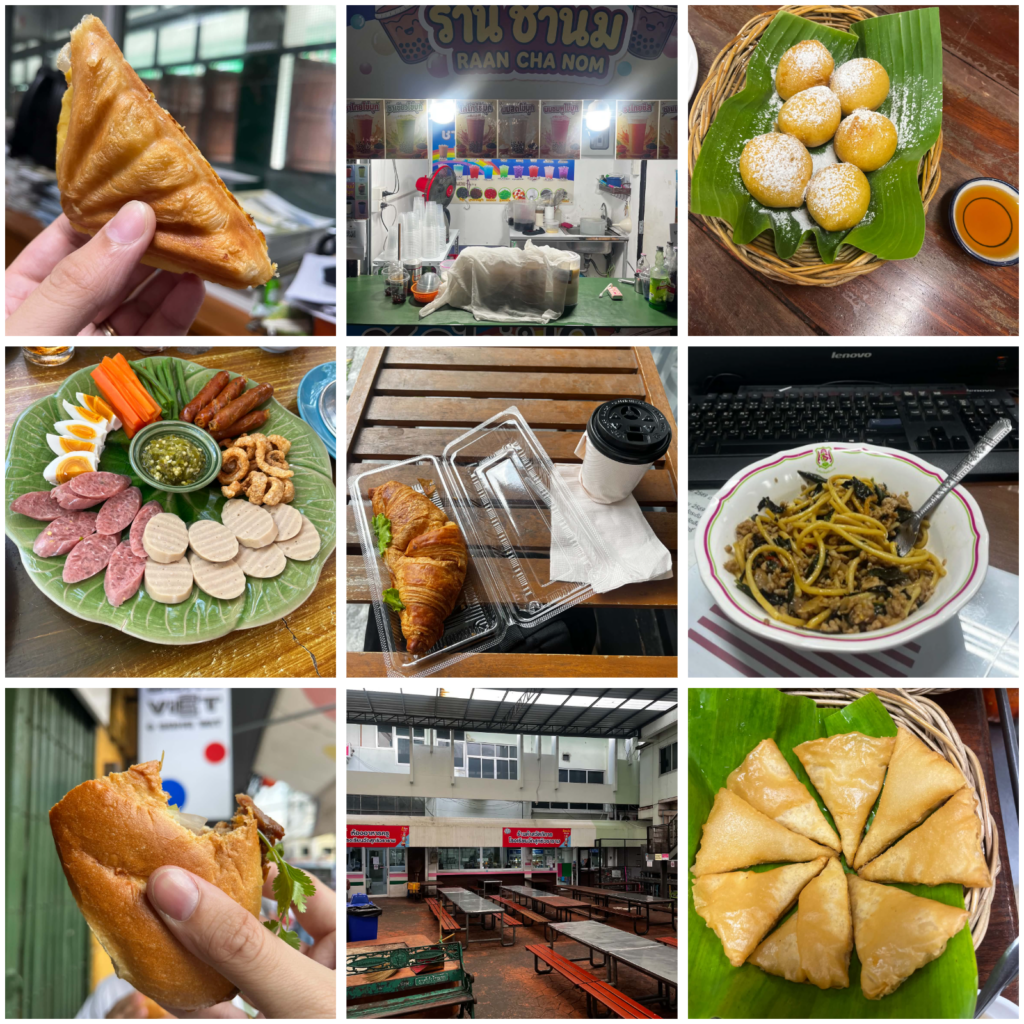
In my second year at SINE, I’ve increasingly found myself increasingly visiting the school canteen. My Thai colleagues have even started teasing me that I eat like a student, which I have decided to take as a compliment.
Instead of leaving campus for a pricier lunch, I’ll grab a waffle or sandwich from the canteen most days.
It’s not really a budgeting trick. It is simply what happens when you begin to feel comfortable enough in a place to participate in it rather than constantly trying to recreate what you’re accustomed to from home.
And that, I think, is one of the less obvious reasons Bangkok can be so livable on a modest salary. The city isn’t inexpensive because everything is cheap, it is inexpensive because you have choices.
You can spend 50 baht on lunch, or you can spend several hundred. You can take the BTS, walk, order a Grab, or hop on a motorcycle taxi. You can eat at the school canteen or, if you have time, sit down at a beautiful restaurant overlooking the river.
The city accommodates all of these versions of life, you simply have to decide which one is yours.
The Strange Economics of Being an Expat
There are also expenses that disappear once you stop thinking of yourself as someone temporarily visiting Thailand and start thinking of yourself as someone who actually lives here.
Our entertainment subscriptions are a good example.
Through AIS, we’re able to get entertainment services such as Netflix, HBO, and Disney+ as part of the Thai subscription ecosystem, so we eventually cancelled our American accounts and shifted over to Thai ones at a fraction of what we had previously been paying.
It’s not a huge amount of money in isolation.
But that’s the thing I’ve noticed about living within a budget: very rarely is there one dramatic decision that changes everything. Instead, there are dozens of little decisions that gradually become your lifestyle.
You eat locally. You walk to work. You buy furniture yourself. You use Thai subscriptions. You learn which things are worth paying more for and which things aren’t.
Eventually, the budget doesn’t feel like a budget anymore.
It just feels like your life.
The Real Luxury of Bangkok
This is probably the part that would have sounded strangest to me before I moved here.
I don’t feel particularly deprived.
I still order Grab Food. I still spend money at 7-Eleven. I still take Grab rides when I don’t feel like walking. I live in a condo with a rooftop and a pool. I have fast internet, air conditioning, streaming services, and a phone that works everywhere I need it to.
I am not living like a backpacker who has reduced his life to the bare essentials.
But I am also not trying to live like I am still in the United States.
And somewhere between those two things, I’ve found a version of life that feels surprisingly comfortable.
Perhaps that’s what the phrase “living within your means” is supposed to mean.
Not denying yourself everything you enjoy. Not constantly checking a spreadsheet before buying lunch. Not treating every small pleasure as an irresponsible financial decision.
Just understanding what your life actually costs, and building a life that fits inside it. For me, right now, that life costs somewhere around 33,000 baht a month. My SINE salary covers most of it.
My tutoring and other work give me additional breathing room.
The occasional training or English Camp adds another little cushion throughout the school year.
And the rest is simply the result of learning how to live here.

So, Can You Actually Live on a SINE Salary?
If you’re considering SINE and you’ve made it this far looking for a simple answer, I think the honest answer is: yes, you can live on a SINE salary in Bangkok — but your definition of “live” matters.
You aren’t going to suddenly become wealthy on 35,000 baht. And you probably aren’t going to live a five-star expat lifestyle every weekend. Everyone’s circumstances are going to be different.
But if you’re willing to live locally, choose your housing carefully, take advantage of the infrastructure around you, and resist the temptation to measure everything against the cost of living back home, 35,000 baht can go surprisingly far.
After a year and a half here, I think that’s the part that has surprised me most. When I first arrived, I thought of my salary as a number I had to stretch. Now, I think of it as a life I have learned how to inhabit. And perhaps that’s the real difference between living affordably and living well within your means.
The former sounds like something you’re enduring, while the latter can feel like some much deserved financial freedom.